
Hope Rising World • Bio-Cosmic Island
A staged program to build a regenerative, AI-orchestrated space habitat and space economy platform.
Bio-Cosmic Island is designed to turn humanity’s long-term dream—permanent, resilient living beyond Earth—into an investable and executable roadmap. The program prioritizes near-term commercial validation in Low Earth Orbit (LEO), scales into cislunar operations, and progressively increases autonomy through measurable safety and performance gates.
Mission
Humanity’s greatest strength is cooperation under uncertainty. We face converging risks—climate disruption, geopolitical instability, and low‑probability, high‑impact events—while the commercial space economy accelerates. Bio‑Cosmic Island is a pragmatic engineering response: a dual‑use resilience platform that advances off‑Earth living and transfers closed‑loop technologies back to Earth.
The goal is not a single leap to a megastructure, but a staged program that produces near‑term commercial value while steadily increasing autonomy, maintainability, and safety.
Core Principles
Gated scaling: grow only after measurable autonomy and safety gates are closed.
Redundancy by diversity: independent pathways; fail‑operational modes.
Human-centered autonomy: automation reduces workload, preserves transparency and override.
Interface-first engineering: open standards for modular, multi‑vendor expansion.
Letter from the CEO
Bio‑Cosmic Island is proposed as a staged program—producing near‑term commercial value while steadily increasing off‑Earth autonomy—so the concept becomes investable and executable.
This statement summarizes the partner whitepaper and is provided for technical alignment discussions.
Oshell Oh
CEO & Founder, Hope Rising World
For partner discussions • NDA recommended
Why a Space Island?
Resilience: planetary-scale cascading risks can disrupt food, energy, and logistics.
Momentum: launch cadence, private stations, and autonomous operations are reducing barriers.
Closure: expensive resupply forces near‑total recycling and efficiency, yielding Earth‑transferable systems.
Bio-Cosmic Island Architecture
Bio‑Cosmic Island is a modular habitat + industrial platform. It expands over time by integrating regenerative life support, AI‑driven operations, in‑space manufacturing, and ISRU‑based supply chains (Moon / near‑Earth objects).
Platform Layers
Layer 1 — Power: generation, storage, and distribution (hybrid, redundant, serviceable).
Layer 2 — AI‑ECLSS: air, water, thermal, waste, and food loops with digital twin control.
Layer 3 — Manufacturing: robotic assembly, additive manufacturing, maintenance.
Layer 4 — Community: governance, education, health, culture, and security.
Near-term value (LEO): microgravity R&D and manufacturing, life-support control software, and infrastructure services.
Mid-term value (cislunar): oxygen/water/propellant supply chains, construction feedstocks, power services.
Long-term value: scalable habitats, large power infrastructure, logistics hubs serving space and Earth markets.
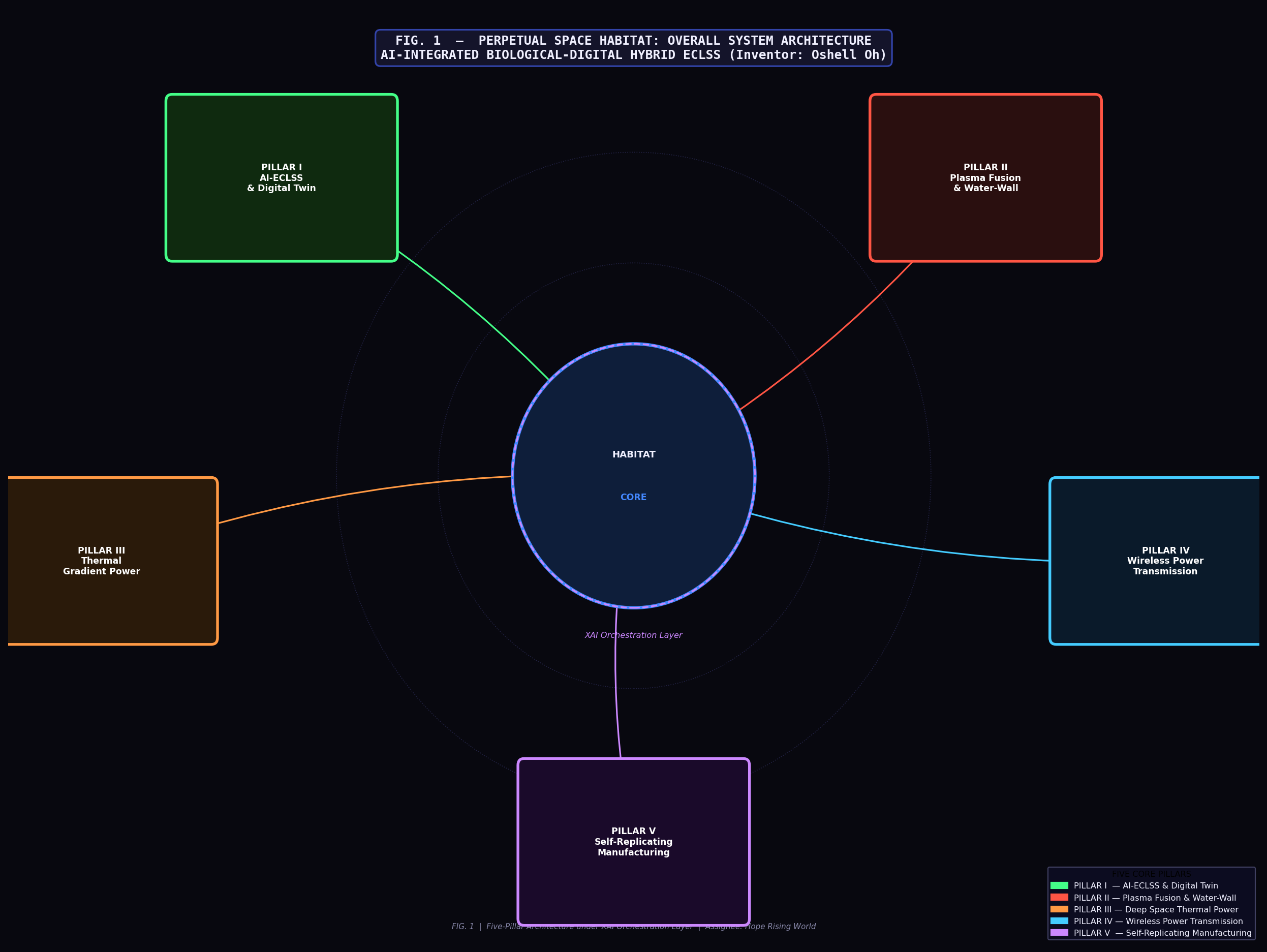
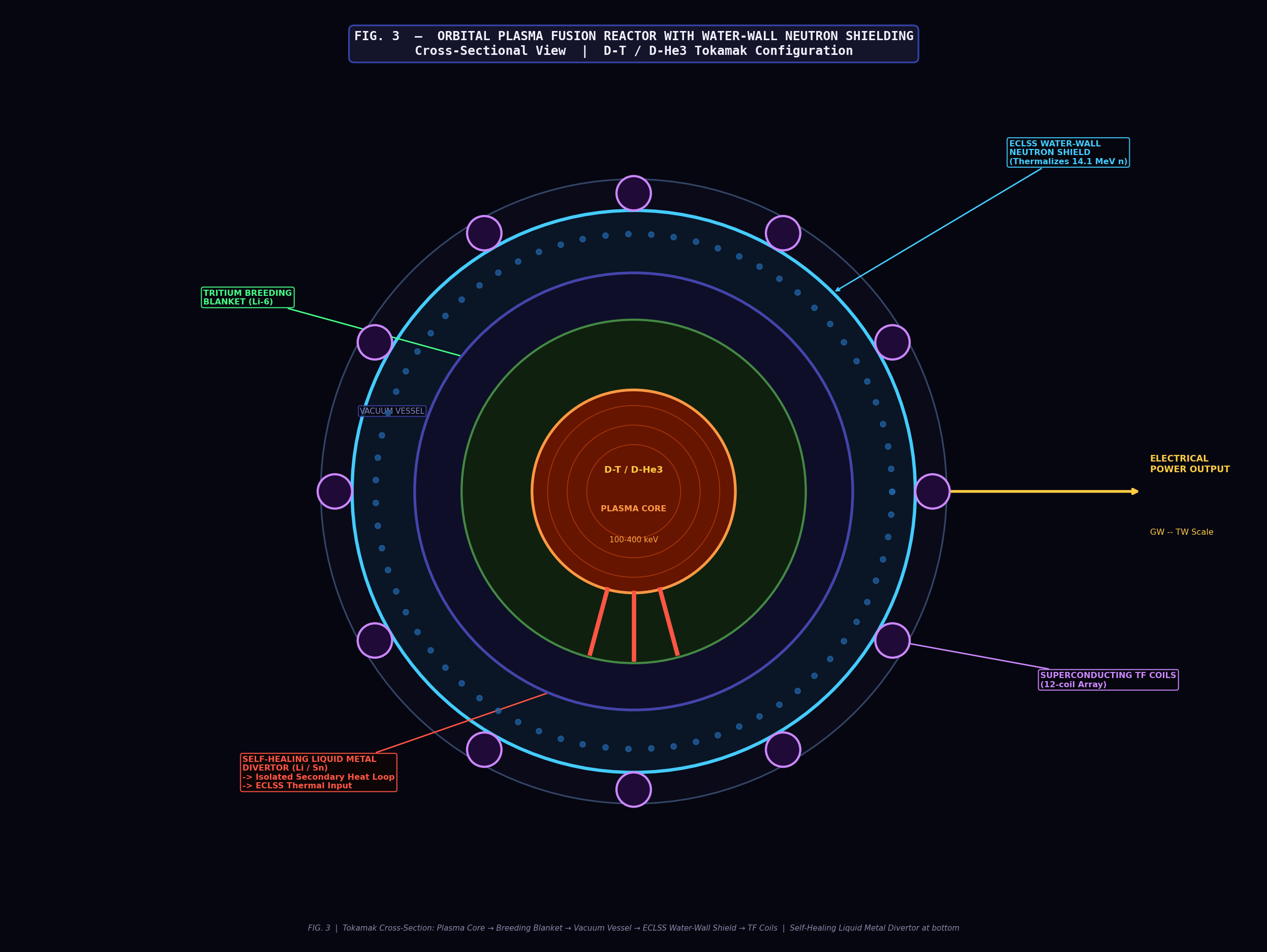
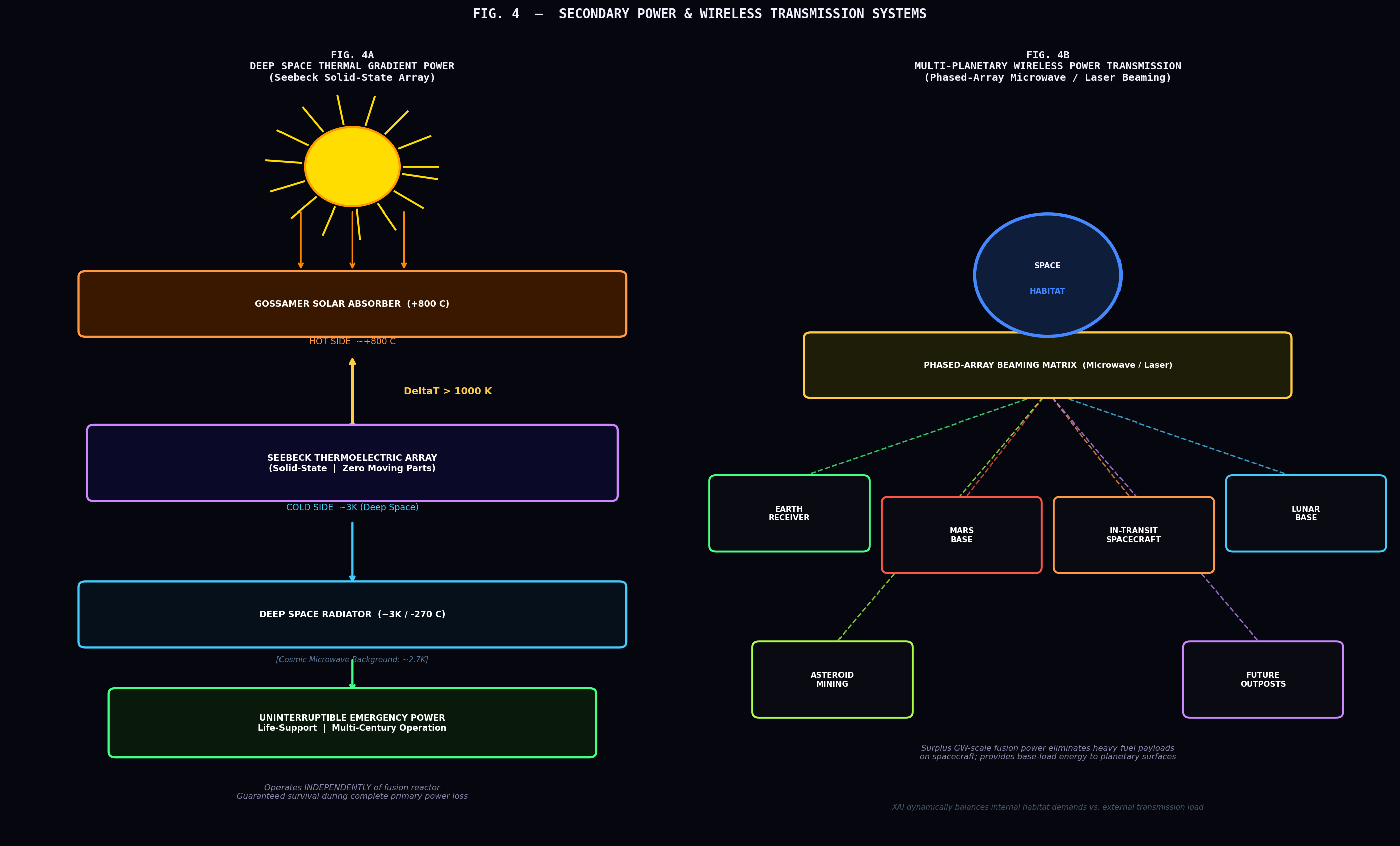
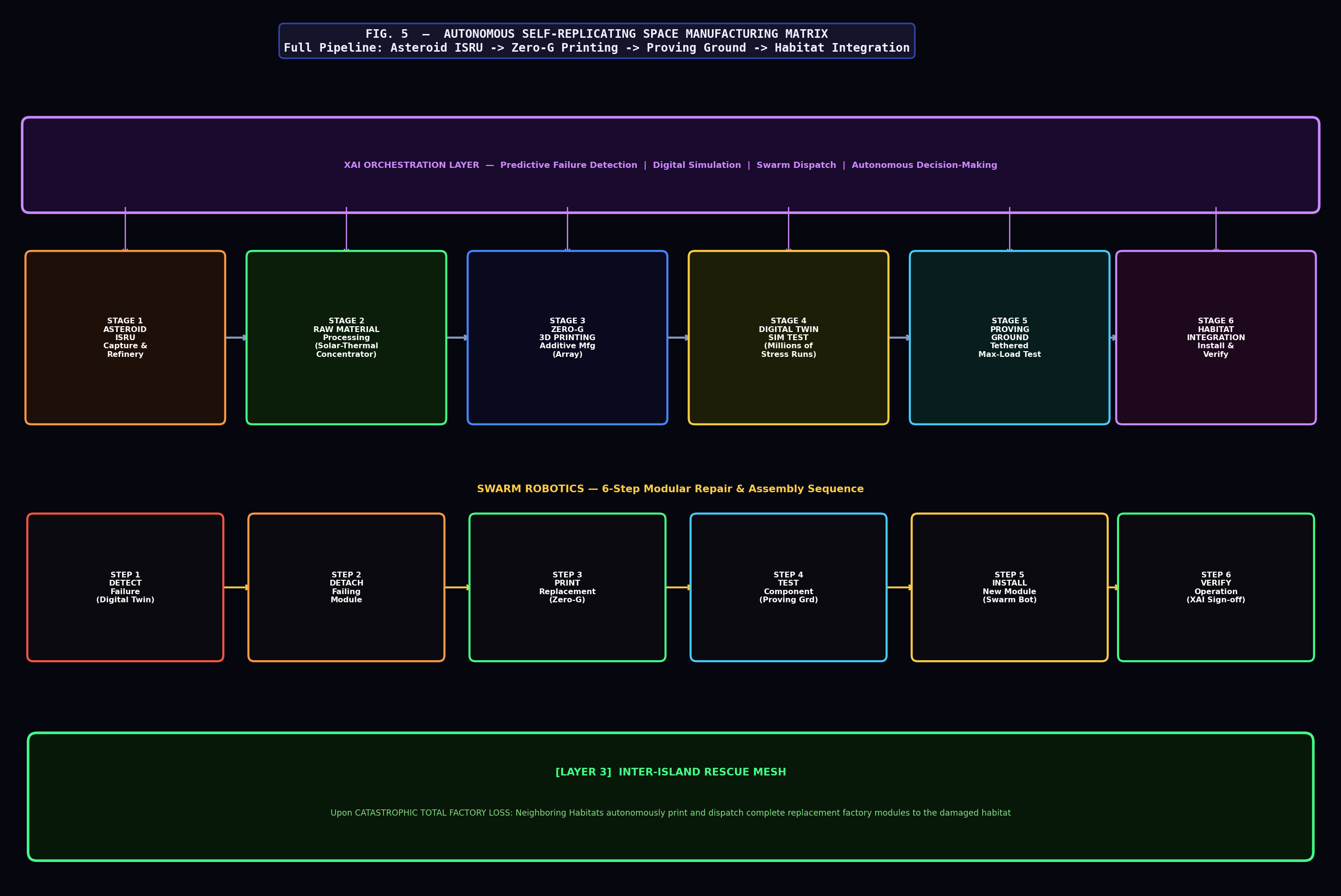
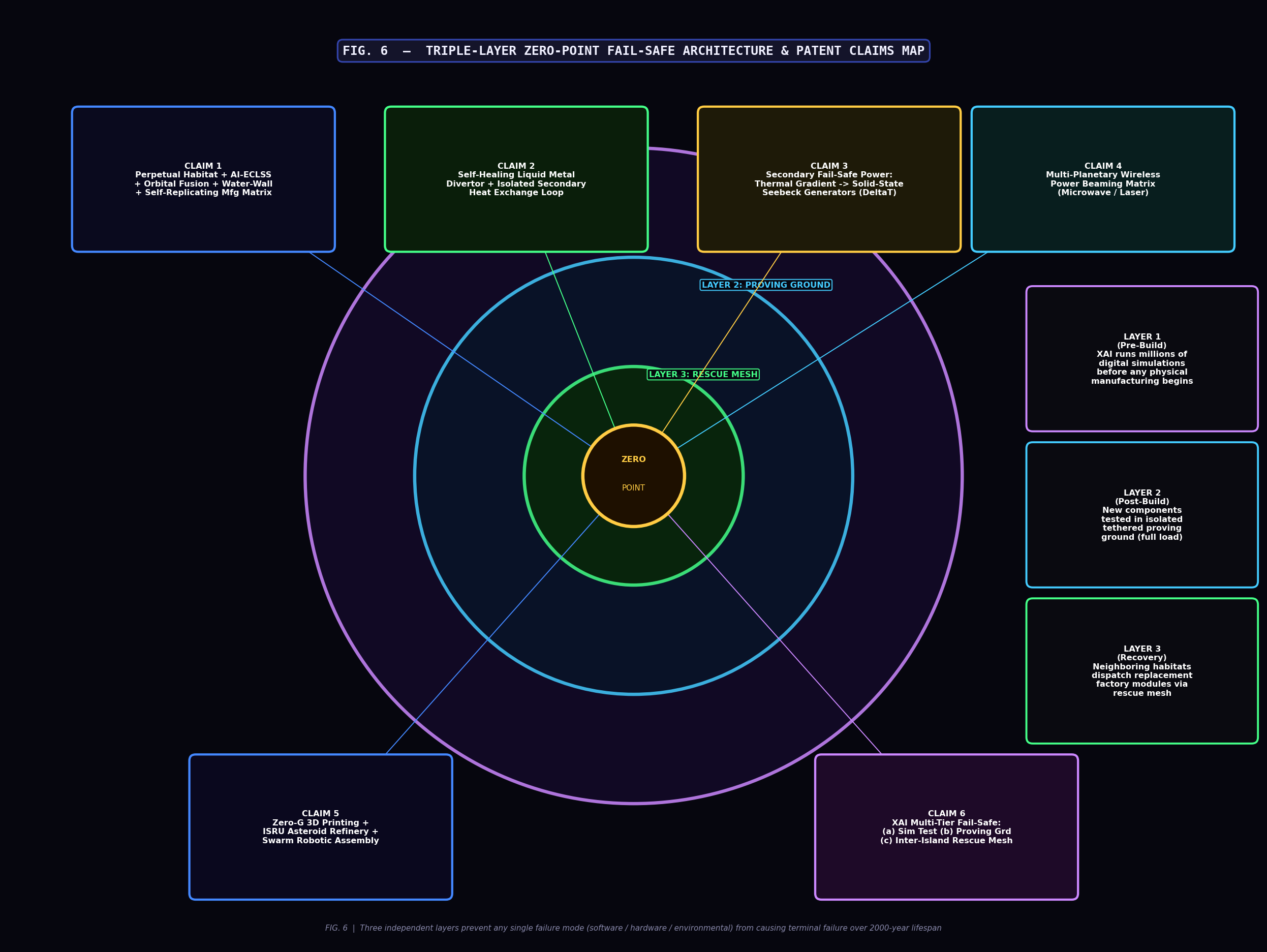
Perpetual Habitat — Five-Pillar System (Provisional Concept Drawings)
The drawings below illustrate a long-horizon “perpetual habitat” architecture described in a provisional patent package. These concepts are presented as research pathways that can be validated through the program’s gated roadmap.

Continuous Clean Power (Program Baseline)
Solar as baseline: large modular PV arrays with robotic inspection and serviceable power electronics.
SBSP as a growth path: start with kW‑class beaming demonstrations; scale to MW‑class for in‑space customers; evaluate later terrestrial services.
Nuclear backup for critical loads: compact fission power as a diversity layer for life‑critical systems.
Storage and distribution: radiation‑tolerant batteries + flywheels near‑term; later integration of cryogenic boil‑off capture and advanced distribution as justified by mass/reliability trades.
Design goal: clean, redundant, serviceable, and scalable power with fail‑operational modes.
Bio-AI Regenerative Life Support (AI-ECLSS)
Closure is the capability: recycle and regenerate water, air, and nutrients with minimal resupply.
Baseline: proven regenerative hardware heritage upgraded for autonomy and maintainability.
Bioregenerative augmentation: staged ecosystem-inspired loops for waste processing, nutrient recovery, then higher food and oxygen fractions.
Control plane: digital twin + explainable closed-loop control + continuous FDIR + cybersecurity-by-design.
Biomanufacturing: on‑demand nutrients and select biomaterials under strict containment and biosecurity governance.
Metric: “food autonomy percentage” tracked as a decision gate to expansion.
Human Health and Habitability
Radiation: layered shielding, dedicated storm shelters, continuous dosimetry, forecasting integration.
Gravity: progress beyond microgravity-only living through rotating test modules and partial‑gravity configurations.
Medical autonomy: onboard diagnostics, protocols for limited resupply, and telemedicine integration.
Manufacturing, Robotics, and ISRU
Additive manufacturing: scale from routine polymer printing to multi‑material structural elements.
Robotic assembly: autonomous inspection, repair, and modular expansion with minimal EVA exposure.
ISRU: staged discipline from prospecting to product qualification; focus on lunar oxygen/volatiles near‑term and cislunar depots mid‑term.
Metric: increasing local production fraction while maintaining safety and certification standards.
Governance, Education, and Community
Bio‑Cosmic Island treats community design as an engineered subsystem. The program includes a Space Island Academy spanning K‑12 through graduate research, delivered through a hybrid Earth‑LEO pipeline supported by digital twins and analog habitats.
Challenges
Choose a challenge track and propose deliverables you can complete, validate, or co‑author.
Challenge Track A
Open Interfaces v1
Draft interface standards for docking, power, fluids, data, safety zones, and multi‑vendor module integration.
Output examples: interface spec, ICD templates, test harness definitions.
Challenge Track B
AI‑ECLSS Digital Twin
Build and validate a digital twin of water, air, thermal, waste, food, and microbial ecology with explainable control logic and FDIR.
Output examples: simulator, datasets, anomaly libraries, validation reports.
Challenge Track C
Autonomous Maintenance
Demonstrate robotic inspection, modular repair, and on‑orbit maintenance workflows (hardware, autonomy, or operations).
Output examples: toolchain, robotic task plans, reliability and safety cases.
Challenge Track D
ISRU to Depot Pipeline
Define staged cislunar supply chains: prospecting → extraction → product qualification → depot operations.
Output examples: process flows, pilot system designs, certification plans, offtake models.
Challenge Track E
Space Island Academy
Design curriculum and training pathways that produce future operators, scientists, and builders—using digital twins and analog habitats.
Output examples: course modules, lab exercises, simulation scenarios, credential pathways.
Roadmap 2030–2050+ (Decision‑Gated)
Expansion is not authorized until safety, autonomy, and economic exit criteria are met.
| Phase | Target Window | Key Deliverables | Example Exit Criteria |
|---|---|---|---|
| Phase 1 Design + Knowledge Convergence |
2030–2033 | Alliance charter; open interface standards; Earth analog habitat program; AI‑ECLSS digital twin; Space Island Academy launch. | Digital twin validated vs. analog data; interface spec v1 released; anchor partners signed. |
| Phase 2 LEO Integrated Demonstrators |
2032–2038 | Flight demo of AI‑ECLSS stack; autonomous maintenance robotics; in‑space manufacturing pilots; microgravity R&D; revenue ramp. | Water recovery ≥95% with fault tolerance; routine ECLSS crew time ≤2 hr/day; safe autonomous anomaly response demonstrated. |
| Phase 3 Cislunar ISRU + Construction Yard |
2036–2045 | Lunar oxygen/volatile pilots; cislunar depot; in‑space assembly yard; beamed power to orbital customers (kW → MW). | Sustained ISRU production runs; depot operations certified; robotic assembly of large truss segments without EVA. |
| Phase 4 Partial‑Gravity Habitat + Expansion |
2042–2050+ | First rotating habitat module; scalable shielding strategy; upgraded bioregenerative food production; expansion‑ready governance. | Multi‑year residence with partial gravity; local production fraction ≥25% then ≥50%; safety case accepted by partners/regulators. |
Partnership Workstreams
Bio‑Cosmic Island is structured as a multi‑partner platform.
| Workstream | Scope | What Partners Contribute | What Partners Gain |
|---|---|---|---|
| Space Transport + Logistics | Launch; crew/cargo ops; rendezvous/docking; reentry | Vehicles; mission operations; safety processes | Anchor service contracts; new orbital demand |
| Habitat + Structures | Modules; pressure vessels; seals; docking; shielding | Manufacturing; certification; materials | Standard‑setting influence; new product lines |
| Power Systems | Solar arrays; storage; power management; beaming demos | High‑efficiency PV; RF power; rectennas; electronics | New markets in space energy infrastructure |
| Bio‑AI Life Support | Water/air loops; bioreactors; sensing; autonomy software | ECLSS hardware; bioprocess expertise; AI stack | Licensable autonomy platform; Earth dual‑use tech |
| Robotics + Manufacturing | On‑orbit assembly; additive manufacturing; maintenance | Robotic arms; autonomy; AM processes | Scale‑up of in‑space construction industry |
| Governance + Insurance | Safety case; standards; liability; compliance; risk transfer | Insurance products; legal frameworks; audit | Early positioning in new regulatory markets |
Engagement Options
Founding Partner: joins the Partner Technical Council; co‑authors interface standards; receives preferred access to pilot payload slots.
Technology Partner: leads a subsystem work package with milestone‑based funding and IP terms.
Research Partner: universities and labs integrating experiments into the LEO validation pipeline.
Anchor Customer: commits to purchase services (R&D time, manufacturing, power, data) enabling project finance.
Resources
Official Whitepaper
Bio‑Cosmic Island — roadmap, architecture, governance model, and partnership pathways.
Provisional Patent Package
AI‑integrated habitat architecture and technical drawings (research pathway).
Contact
Hope Rising World — Office of the CEO
Email: partnerships@hoperisingworld.org
Suggested subject line: Bio‑Cosmic Island Partnership Inquiry
Earth Issue Reporting
Upload photos or short videos (≤ 5 minutes) showing urgent problems that require global engineering solutions.